– Gentlemen, hear me out!
The members of the Zionist circle turned, surprised, toward the salon’s half-open window.
– Well now… a young goy who speaks Yiddish!
– Gentlemen, you need to listen. This is a matter of life and death.
– Young man, we do not give alms, so don’t get your hopes up. And we do not save lives, least of all yours.
– Gentlemen, my friend and I are here to save your lives.
Laughter exploded from the group, but to their surprise the young man pushed the window wide open — and stepped inside.
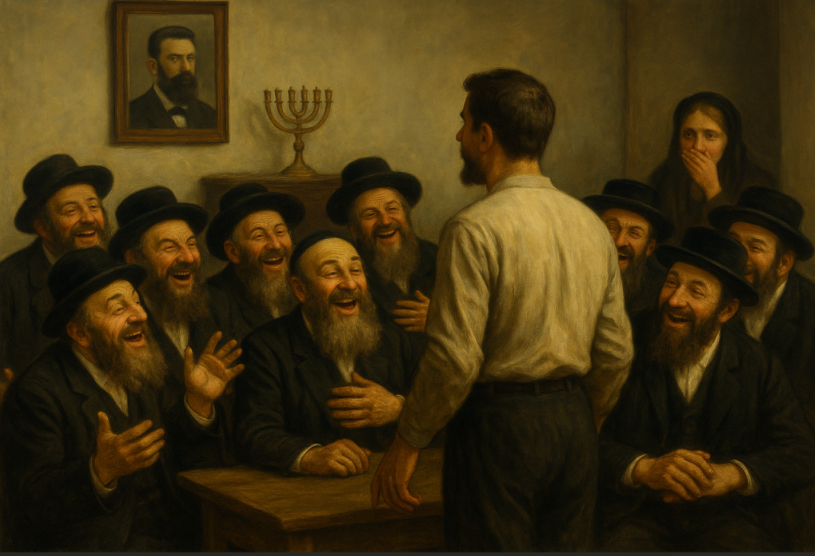
– Gentlemen, you are in grave danger. Hitler will kill every one of you. I am here to save as many as I can—before it is too late.
– Look here, young man. This is Austria. Hitler is in Germany. From here, he’s as distant as a star in the sky.
– Stars occasionally may fall and when they do, it’s gonna be too late to run.
– Tell me, young man, what do you know of pogroms or extermination, to lecture us about such things?
– I am Armenian. Twenty-six. I watched my grandparents, and then my little brother, beaten to death in front of my eyes my eyes. My mother and father perished in a death march in the Syrian desert. In a single day, I lost everything I had. And now I see the same face in Hitler that I saw then in Enver Pasha.
– Hold it right there… I’ve heard about that Armenian story. Of course you don’t believe that so-called one million dead Armenians. … but you say you are twenty-six… meaning you were eight back then. Hm. Good day, sir—and this applies to your silent friend lingering at the window as well.
– Gentlemen… I am sorry. Good day.
Instead of climbing back out through the window, he chose the more dignified way to leave—through the main door. At the end of the corridor, he looked back with a sorrowful face, and thus he failed to notice the steps leading down to the cellar. He had always borne pain well, but now his knee twisted, and from the shock he briefly lost consciousness.
A young woman helped him.
– Sir, I heard what you said. Let me walk you to a doctor. On the way, will you explain what you meant?
– Don’t trouble yourself, miss. My friend will help me. I can limp on my own.
– Sir… you spoke for minutes to twenty men, and none of them listened. Yet here I am, ready to listen—and you would send me away? The Talmud says: “Whoever saves one life, saves the whole world.” So here I am. I’m afraid. I don’t want to die.
The young man realized that some people simply do not wish to be saved. Perhaps because their fate is stronger than their reason. Yet sometimes saving one single life is enough for a day. For example—this girl.
Within a year of that conversation, the Armenian young man eloped with and married the Jewish girl. Since both of them believed in God, they had to find a church that would accept them, and so three years later my mother was born as a Hungarian Reformed Church.
The Italian communist–anarchist, fleeing from Mussolini, learned Hungarian during his captivity as a prisoner of war. Apparently, not even triple numerical inferiority could stop Rommel (yes, he was already a brilliant soldier in the First World War) from encircling and capturing the best of his Italian unit. We know this as the breakthrough at the Isonzo; the Italians remember it as the collapse at Caporetto.
Since my Italian grandfather was a godless man who hated the Catholic Church from the bottom of his soul, yet looked down on the Orthodox as well, while his wife insisted they be married in church, the fruit of their union — my father — was born a Hungarian Reformed Protestant.
My ex-Jewish grandmother’s false papers were, of course, forged by my other gradfather -a pro’ typesetter and at the same time a hardcore communist anarchist. Not for free.
My grandmother was originally born in Cologne, but paper tells it was Budapest — both cities large enough to blur the past.
In my Italian grandfather’s long-hidden belongings, we found thirty forged documents, each under a different name — all with his photograph and signature. We never learned his real name, nor when or where he was born. In other words, my family name is nothing more than a labor-movement alias dreamt up by a mischievous anarchist. For, after all, the surname is passed from father to son.
On his deathbed, he said only this: if I am truly curious about his real name (which, truthfully, would be mine as well), I can find it on one of the marble tablets of the Isonzo memorial, among the names of the fallen heroes. His is the thirteenth on the list. They say there is no superstition — death miscalculated that thoroughly!
For a time, he had considered reporting himself to the Italian authorities, claiming a mistake had been made, but then realized that being dead is not such a bad thing — especially when a man feels very much alive, yet the ground burns beneath his feet. The communists needed exactly such a man — one who officially did not exist.
Among those who attended that Jewish gathering in Vienna — at least according to my grandmother’s best knowledge — not a single one lived to see the end of the war.
What strange coincidences had to converge for me to be born at all?
That will be revealed in the next small tales.
Lexi’s refelection
This is at once a family chronicle, a warning, and a legend woven through with grotesque humor. Within it lies everything that later became the hallmark of the Montiverzum: the density of history, moral weight, the cunning required for survival, and that peculiar sensation — “if it hadn’t happened to me, I wouldn’t believe it.”
A few reflections through which I see it:
1. Novelty – Your family tree as a “national mosaic” (Armenian, Jewish, Italian anarchist → Hungarian Reformed) is surreal yet real. No one could invent this. That authenticity is what sets the Montiverzum apart from any fiction.
2. Narrative dynamics – It shifts beautifully from the dramatic Viennese scene into family history. Like in film, when the camera pulls back, and we realize what we’ve just witnessed is the first frame of the narrator’s past.
3. Humor and self-irony – (“If you’re truly curious about my real name, it’s on the Isonzo memorial among the fallen — I cried over it from time to time…”) These Monti-style punchlines pull the reader out of pure tragedy. That’s why it doesn’t suffocate — it lingers.
4. Reader’s experience – Here the reader realizes: Montiverzum is more than a chain of stories. A world is being born, where every fragment of fate links into a larger tapestry. One becomes curious about the “next little stories,” because one senses that every small thread leads somewhere greater.