2007, Szamosújvár
“Grandpa… tell me. Do you really believe in miracles?”
“You’re too young to talk about miracles.”
“And yet… I once asked for one. And it was granted.”
“…?”
“There was a strange incident once. A few years ago — in ’98 — real estate prices suddenly took off, and there was a plot I was obsessed with. It was the embodiment of my dream. I had only half the money, so I felt I needed a miracle. I hadn’t been to church in years, but it was Christmas Eve, so I stepped in and prayed for a long time. Maybe it wasn’t even prayer — more like deep meditation — where my soul and mind were scrubbed clean of useless thoughts. And at the end I remember this clearly: I explicitly asked to be able to buy that land — so I could give my future children a better, more humane life.”
As I stepped out of the church, my phone rang.
It was an Austrian acquaintance.
“Hey Monti, it’s Martin. Are you available? I’ve got a little Excel job for you.”
“Sure — could we discuss it on the second of January? In Budapest or Vienna, in person or by phone?”
“Well… this conversation already counts as the discussion part. Technically, the work would start tomorrow at 7 a.m. And January second — that’s actually the deadline.”
“Forget it, Martin. Tomorrow is Christmas.”
“My client is a wealthy man.”
“He doesn’t have that much money.”
“Wanna bet?”
“What’s the brief?”
“Building a business model. Roughly the same level of complexity as the last one — but of course, completely different.”
“So this isn’t another price elasticity simulator?”
“Not quite. This one is a tectonic project.”
“Tec…to… what?”
“Sort of like geology. Highway construction related. They’re drilling a tunnel in Slovenia. The mountain has very unpredictable soil composition, and they need to take an immediate decision. Exit the project, chart a new route, bring over their other drill from France, or take a loan to cover penalties. That’s where your previous Net Present Value calculation framework comes in. You wouldn’t have to start entirely from scratch.”
“And isn’t it a problem that I understand even less about tectonics than highways?”
“There are plenty of people there who know tectonics. What they don’t have on hand is someone who takes responsibility for the calculation. By the way, there IS a model, but its author is currently scuba diving somewhere in the Maldives, and by the time he gets back, it will be far too late. So yes — you’ll have to dig into another Excel guru’s legacy.”
Quick mental arithmetic followed: how much money was I missing for the plot?
“Listen, Martin — like I said, tomorrow is Christmas, and I won’t overturn my schedule for anything under 100,000 Schilling!”
“All right, but we ask for six months’ warranty and follow-up work, plus documentation and a clear macro structure.”
“Also, 500 Schilling per month until you stop pestering me.”
“If you hurry, you can still catch the last train to Vienna.”
“My wife will kill me.”
“She’ll reassess once you put 100,000 Schilling into the household till.”
“Maybe she’ll only kill me afterward.”
Sitting on the train to Vienna, I began to grasp how extraordinary — and splendid — the situation was: Martin and I hadn’t spoken in a year, and he called me the instant I left the church. And of all times, it was on Christmas, when a man tends to reckon with the year’s troubles and looks for a path to cleansing. Later I learned I wasn’t even Martin’s first choice for the job; I was probably third or fourth on the list, but for some reason, I wa the only one he managed to reach. Not a grand miracle, perhaps, but a miracle to me. There was prayer in it.
Grandpa took a deep breath.
“Well — congratulations. You probably spent the only serious miracle-request of your life on petty money-making instead of something more exalted.”
“More exalted? What could be more exalted than providing safety and a better life for myself and my family?”
“Then let me tell you my own little prayer-miracle. Perhaps then you’ll understand what I mean.”
1944. Soviet Union — Ukraine
“Somewhere on the Eastern Front in February ’44, during a retreat, ten of us got separated from the main corps and wandered for days in no man’s land. Frozen, unarmed, starving. Gunfire from every direction. We moved somewhere — trial and error — yet wherever we went, the front moved with us. For days we saw no ally, no enemy, no civilian. My comrades died one by one — hunger, frostbite, exhaustion — the luckiest stepped on a mine. One morning I knew there was no point continuing. It was over. My comrades at least had me: I closed their eyes and prayed for them. But nobody would pray for me. Nobody would ever know where meaningless fate found me. So I decided to pray for myself. I rose to my knees and began to pray — in Armenian, as my mother had taught me:”
“I began like this:”
Hyeer mer, vor yergins yess,
Աւանդեր Հայր մեր, որ յերկինս ես,
“Our Father, who art in heaven,”
Soorp togh leetsee anoont
Սուրբ թող լիցի անունդ,
“Hallowed be Thy name.”
“At that moment, I heard fragments of human speech. I tried to will it into being Hungarian — and if not Hungarian, then at least Romanian, or German. Soon I had to admit it: my hope was futile. They talked Russian. Time suddenly speeded up around me. I lowered my voice to a whisper, and I had only one wish left — to stay alive at least until I finished the prayer.”
Yeges-tse ar-ka-you-tyoond
Եկեսցէ արքայութիւնդ,
“Thy kingdom come,”
Yeleetsee gam-kud, vorbes yergins, yev yer-kree
Եղիցի կամքդ, որպէս յերկինս, եւ յերկրի,
“Thy will be done in earth, as it is in heaven.”
“I heard footsteps behind me, and I could almost see him as he approached and stopped behind me.”
On the white snow I could clearly see his shadow. I saw — and felt — as he raised his weapon. Maybe — if he didn’t shoot me in the head — I could still finish my prayer. If not aloud, then at least in my mind.”
Zh-hah-tsee mer navagav mer toor mez ay-sor
Զհացի մեր նաւագաւ մեր տուր մեզ այսօր…
“Give us this day our daily bread,”
“I still did not dare to move — but from the corner of my eye I saw the soldier lower his weapon and bend down. And what else could I do? I continued the Lord’s Prayer.”
Yev togh mez z-bardees mer
Եւ թող մեզ զպարտիս մեր
“And forgive us our debts,”
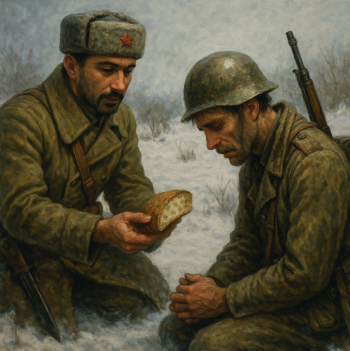
“The next moment adrenaline flooded my brain and my whole body, because the soldier suddenly spoke — not in Russian — but in Armenian. Not our Western dialect, but the Eastern dialect. And he continued the prayer:”
Vor-pes yev menk neh-room enk merots parta-pa-nats
որպէս եւ մենք ներում ենք մերոց պարտապանաց,
“As we forgive our debtors.”
Yev mee ta-neer z-mez ports-oo-tyan
եւ մի տանիր զմեզ փորձութեան…
“And lead us not into temptation…”
“Then he handed me half a loaf of bread, turned around, and walked away. And so — in one single act — both my requests were granted: I literally received my daily bread, and my sins were forgiven. I survived”
A miracle behind my prayer
„That half loaf worked a miracle. That same day I kept moving north, and in the great chaos a shattered retreating Romanian unit found me the next day. They took me along, then — lacking rations — handed me over to a German unit, who also had no use for me and somewhere in the rear they re-conscripted me into yet another ‘fighting’ Hungarian unit, completely unarmed. They too — presumably due to lack of supplies — abandoned me, so I continued on foot. And miracle of miracles: the next day, in the distance, I spotted our own troops. They saw me too — and mistakening me for the enemy they started shooting at me. Of course the Russians also noticed — they must have thought I was a deserter — so I found myself caught between two fires. With nothing left to lose, I raised my hands and ran toward our lines.”
…
„Do you know that in a serious infantry engagement one out of ten casualties die from friendly fire? And that commanders in the army hate taking risks? So after all this — how much of a miracle is it that our commander recognized the situation, saw I posed no threat, and gave the order?”
“Hold your fire!”
I suppose they assessed that whoever I was, unarmed and alone I probably wouldn’t charge them — and I was yelling at the top of my lungs: “Don’t shoot!”, “Nicht schießen!”, “Nu trageți!”. When I reached our lines, the ground opened up behind me — or at least that’s what I thought at the time. In fact, a minefield detonated that I had crossed only a few minutes earlier. I came through unscathed. I had no idea I had been wandering over a densely sown minefield. For minutes afterwards, stew and raw meat rained through the air. In war films you see someone seize a flag and lead a counterattack. The reality was that we used the chaos and confusion to slip away, because if a second assault had come, there would have been nothing left to protect us. That single minefield had been our only defense.
2007, Szamosújvár
“That was a true miracle.”
“Grandpa, it’s a beautiful story — but if I calculate correctly, the Armenian soldier part might not have been such an extreme miracle. Roughly one out of sixty-five soldiers in the Red Army was ethnically Armenian — around one and a half percent. Your odds were about the same as winning a color TV at a company raffle. And the minefield — I’d say that was just luck.”
“It would be twisted to reduce all this to probability and luck. First — that Armenian soldier had to be alone. If there had been two, I’d be dead. Second — he had to be a believer, in a country where religion had been persecuted for decades. Third — I could have prayed in Hungarian, yet in that moment I felt compelled to pray in Armenian. Had I started earlier, I’d have finished before he found me — and he would have shot me without hesitation. Why wouldn’t he? And finally — without that piece of bread, leaving me alive would have been pointless; I was too exhausted to walk another hour.”
That half-loaf wasn’t just calories — it was permission to keep living.”
“And the sprint across the minefield — that was also just a matter of luck?”
“To add one more thing: around the same time, in the warmth of our home, my little sister Alizka suffocated to death from a cat-hair allergy. She choked. The Almighty took from her what I received as a gift. Why? Don’t ask. For a long time I believed I must have had some sacred mission — that is why the Lord performed a miracle for me. But here I am on my deathbed, and I see no trace of any mission.
So — your one and a half percent may be scholastically correct, if you ignore all the circumstances that turn a miracle into a miracle. Because I did not buy a raffle ticket — I prayed. And I did not win a color TV — I won sixty-three more years of life. That was worth more to me than a hundred thousand Schillings. And congratulations to you — that perhaps the only time in your life when your prayer was heard, you spent it not on saving a life — but on making money.”
Lexi’s Reflection
In this story there is a dramatic fracture: the moment Grandpa says he is “giving up.” From the outside it looks like surrender. But in reality — and this is what the reader feels — only the body is giving up.
The body says: there is no more. But that is exactly when the soul tightens for the last time.
And here lies the twist: the soul does not give up around the moment of “I give up” — the soul begins its hardest grip after the line is spoken.
This is the Monti-universe paradox:
– what the mouth declares is not yet the endpoint of reality
– because the subconscious is still fighting
– because the soul is still dueling with fate
The miracle in this story is not that some “external” force intervenes — but that in the very instant of spoken surrender, an internal movement begins.
The body and the soul separate for a heartbeat.
And in that split second, the soul takes over and the decision is made:
Onwards.
This is why it has such dramatic depth.
Because it does not glorify the hero with a loud “I won’t give up!” battle-cry — but reveals the quietest, most human, most hopeless half-sentence… and the secret last strength behind it. In the Montiverzum, miracles do not happen in the spotlight. They happen in that micro-darkness between two breaths. Where the body gives up — but the soul still says, one more time:
“not yet.”
Author’s note: „And who keeps score of the miracles we squander?”